
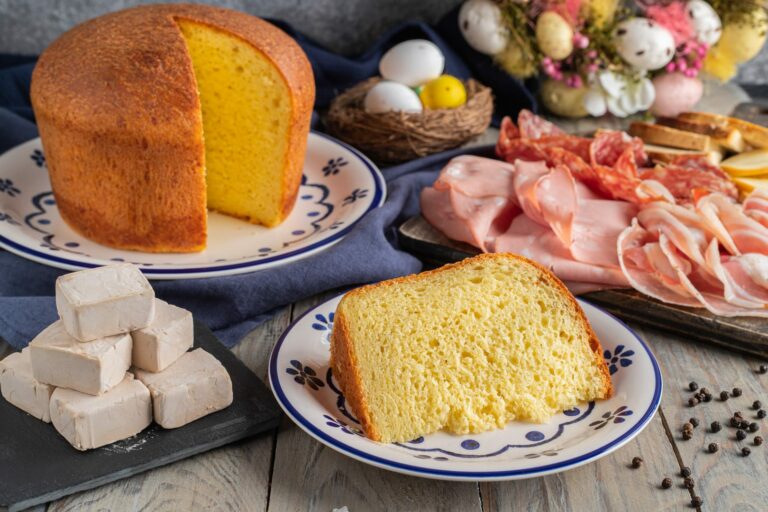
If chocolate eggs are the stars of Easter, in the Marche there's also a “savoury side” to savour and enjoy!
In the Pesaro area, it's called “crescia brusca”… in the Ascoli area, “crescia di Pasqua”… but it also goes by other names like “ciaccia”, “torta” or “cheese pizza”! It's the savoury side of Easter, not just in the Marche but across the heart of Italy.
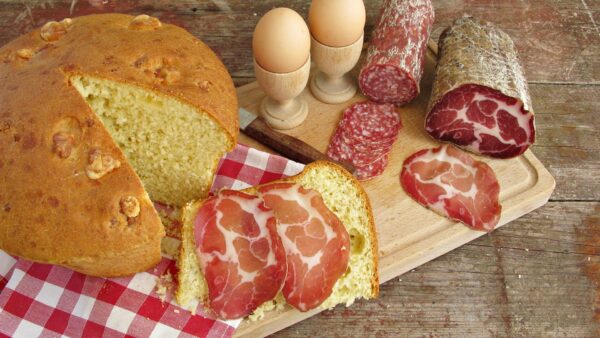
There, where the Apennines act as a hinge and traditions bind together pieces of Tuscany, Abruzzo, Lazio and the whole of Umbria (the region that has registered this bread as a Traditional Agri-Food Product with the Ministry of Agricultural Policies).
A great leavened bread, the “Pizza di Pasqua” (Easter cheese bread), is not something to improvise — it demands know-how, knowledge and experience. The dough must be worked for a long time to develop the gluten network and encourage rising, which must happen twice over to give the bread its lightness.
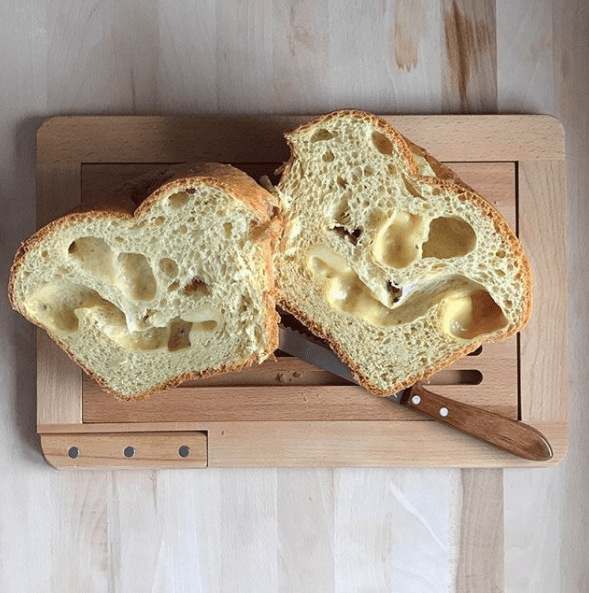
A delight of folklore with a prestigious literary pedigree: it's mentioned in the Eugubine Tables, dating from the 3rd-2nd century BC, a ritual text written in Umbrian, Etruscan and Latin, and also by Cato in his treatise “De Agri Cultura”, where the “torta” is dressed in bay leaves.
The Ancient Roman recipe is also very simple: cut 300 grams of cheese, crush it in a mortar and mix well with 150 grams of flour and half an egg. Shape the dough into a round. Line the baking tray with bay leaves and place the libum (flatbread) on top. Place the testum (a lid containing embers) over the tray, with hot coals above and below. Bake for 20-30 minutes until golden. Originally cooked over a hearth, but it works well in a fan oven too.
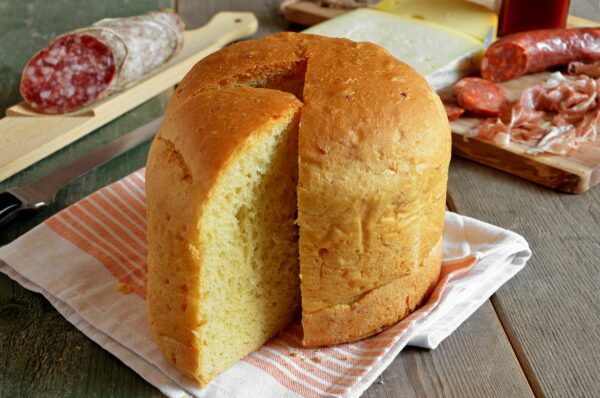
The goodness of the Pizza di Pasqua comes from the balance between its ingredients.
The spicy kick given by the pepper and the various cheeses mustn't dominate, and the dosing of the different cheeses must be done with real skill.