
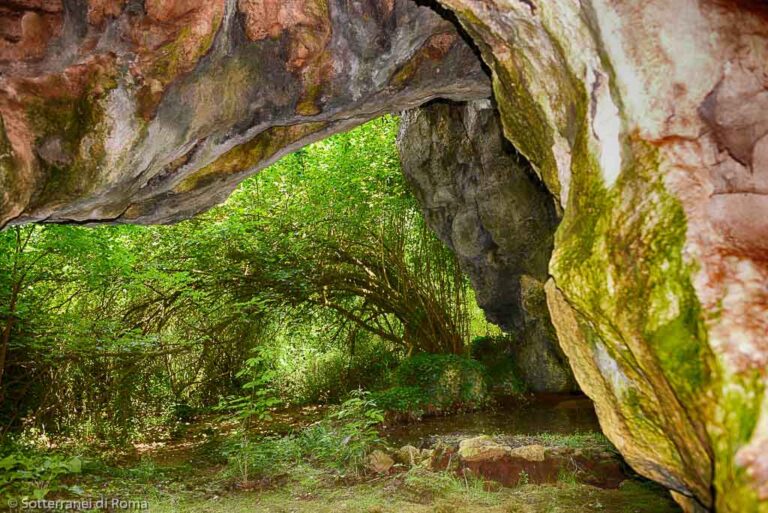
There's a little-known cave just outside Rome with rock paintings and sculptures carved by water: it's the Grotta dell'Arco di Bellegra, a village of 2,700 inhabitants in the upper Aniene Valley: a natural cavity, inhabited since the Iron Age, which became a votive temple in the archaic era and, in the last century, a mill for grinding grain.
Its opening up to cavers, and later to tourists, is a recent chapter in its history. The cave stretches for about a kilometre. The entrance is preceded by a green area and a small bridge over a stream that flows out of the cave and reaches the arch; from there, you step straight into the typical cave environment, with stalactites, stalagmites, sinkholes, small lakes and streams.
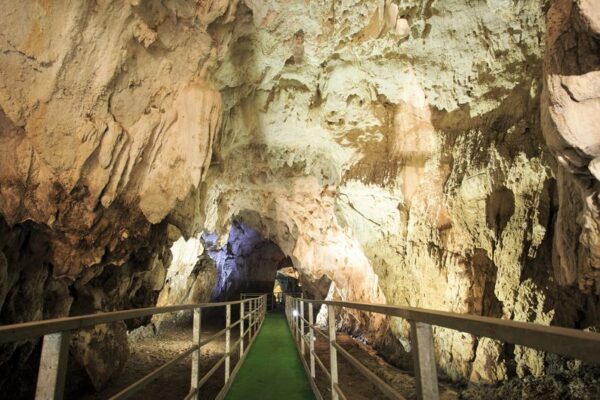
The Grotta dell'Arco di Bellegra has a history spanning thousands of years, and not just from a geological point of view: it is an outlet of an ancient lake – the Pantano di Roiate – where water has slowly, and with infinite patience, shaped the natural sculptures that characterise it. But its greatest added value lies in human history, which overlays the natural one.
In the Iron Age it served as a refuge and shelter. This is attested by the carvings depicting hominids hunting, which can still be admired along the visitor route. The cave later became, thanks to a votive well, a sanctuary of ex-votos which, even today, are still found during speleo-tourism visits.
The cave can be visited via two separate routes, a tourist route and a speleo-tourist route. There is also the possibility of a third, "advanced" route, reserved for experts.
The paintings were only discovered after the installation of the metal walkway in the 1990s, when the many cavers who visit the cave each year were no longer forced to struggle through the thick layer of mud that covered the entrance area, and were finally able to take a proper look at the morphology of this part of the cavity.